C Major Scale
C major is considered the 'home' key of Western music — pure white keys on a piano, no accidentals. Its open, balanced sound makes it the most common key for beginners and a favourite for composers who want clarity without colour.
Notes in C Major
The C major scale contains seven notes: C — D — E — F — G — A — B. All major scales follow the same interval formula — tone, tone, semitone, tone, tone, tone, semitone (T T S T T T S) — applied starting on C.
C major scale on piano and guitar
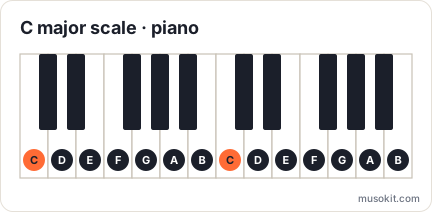
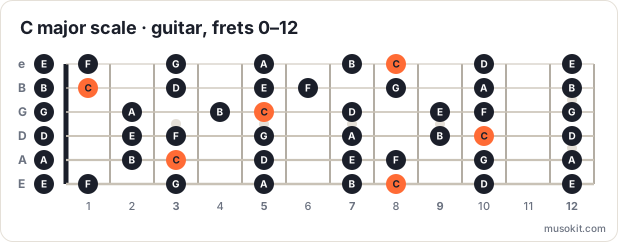
On guitar, the root C sits at fret 8 on the low E string and fret 3 on the A string. Start there, play every marked note up to the next C, and you have played the whole scale.
Scale degrees of C major scale
| Degree | Note | Interval from C |
|---|---|---|
| 1 | C | Root |
| 2 | D | Major 2nd |
| 3 | E | Major 3rd |
| 4 | F | Perfect 4th |
| 5 | G | Perfect 5th |
| 6 | A | Major 6th |
| 7 | B | Major 7th |
Key Signature
The key signature tells you which notes are permanently sharped or flatted throughout a piece. C major has no sharps or flats. Its relative minor is A minor — a scale with identical notes but a different tonal centre.
Diatonic Chords
Every major scale generates seven diatonic chords — one built on each scale degree. For C major those are:
In detail: C major, D minor, E minor, F major, G major, A minor, B diminished. The I, IV, and V chords are major (the 'primary' triads); ii, iii, and vi are minor; and the vii chord is diminished.
Famous Songs in C Major
Many iconic recordings were written or recorded in C major:
- "Imagine" – John Lennon
- "Let It Be" – The Beatles
- "Clocks" – Coldplay
- "Someone Like You" – Adele
How to Practise C Major
Practice C major as a two-octave ascending/descending run. Because every note falls on a white key, C major is ideal for building finger independence before tackling keys with accidentals.
Use the MusoKit scale explorer to see C major on an interactive piano keyboard and guitar fretboard, play it back with audio, and explore all seven diatonic modes built from its notes.
Modes of C Major
The seven modes of C major each begin on a different scale degree while keeping the same notes. Starting on the first note gives you C Ionian (identical to C major); starting on the sixth gives you A Aeolian (natural minor). Open the scale explorer and select each mode to hear how the tonal character shifts while the notes remain constant.
FAQs
What are the notes in the C major scale?
The C major scale contains: C — D — E — F — G — A — B. There are seven notes, following the whole-step/half-step formula W–W–H–W–W–W–H.
What chords are in the key of C major?
The seven diatonic chords of C major are: C major, D minor, E minor, F major, G major, A minor, B diminished. The I, IV, and V chords (C, F, G) are the primary triads and form the backbone of most C major progressions.
What is the relative minor of C major?
The relative minor of C major is A minor. They share the same key signature (no sharps or flats) but have different tonal centres — C major sounds bright and resolved, while A minor sounds darker and more emotionally ambiguous.
How many sharps or flats does C major have?
C major has no sharps or flats. This makes it one of the most straightforward keys to read.
What is the C major scale used for?
C major is considered the 'home' key of Western music — pure white keys on a piano, no accidentals. Its open, balanced sound makes it the most common key for beginners and a favourite for composers who want clarity without colour. It suits a wide variety of music genres and is an essential scale for any musician to know.